
Rat & Mouse Repeller
Repello — ultrasonic rat and mouse repeller, effect documented in a 2025 SLU pilot study. Poison-free, silent to humans and pets. Sold in Bali, Indonesia.
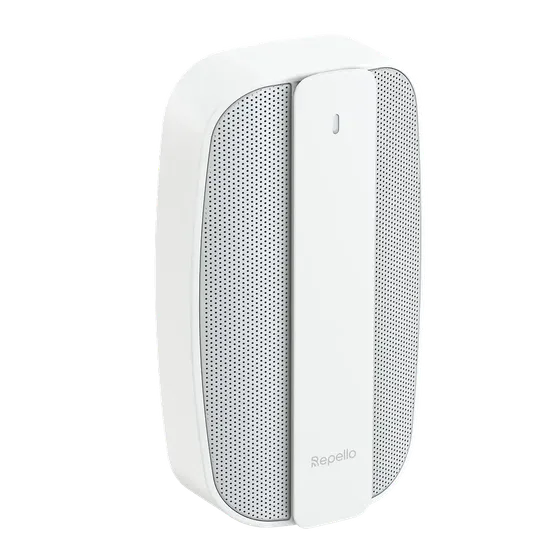
Rats come with the territory on Bali: open kitchens, dry stores, roof voids above the ceiling, generator rooms. Poison and traps leave a dead rodent somewhere you cannot reach — in a hotel or restaurant, a bigger problem than the rat was. Repello works the other way round: it plays back the rats' own alarm signal, pulsed ultrasonic sweeps of 25–85 kHz, so the room reads as unsafe and the animals leave. The pattern shifts continuously, so they do not get used to it — in a 2025 SLU pilot study, rat sightings in the monitored corridor dropped by more than 90% against the control week.
It is silent to people, dogs and cats, with nothing to clean up. One unit covers up to 40 m² of open space, and ultrasound does not pass through walls, so plan one per enclosed room: kitchen, store, roof space, garage. It plugs into an ordinary socket, with nothing to set.
Common questions
Is an ultrasonic rodent repeller safe around children and pets?
Repello is completely silent to humans, dogs and cats, and there is no poison and no trap in the house. That is the practical reason hotels and restaurants use it: nothing a guest, a child or a pet can get into, and no carcass to find later.
How many units do I need?
One per enclosed space, up to 40 m² of open floor. Ultrasound does not travel through walls or closed doors, so a kitchen, a dry store and a roof space each need their own unit. Two- and three-unit packs are available — tell us the rooms on WhatsApp and we work out the count with you.
Does it work on mice as well as rats?
Yes — one device for both. The signal is the alarm call rodents use to warn each other, so rats and mice react to it the same way. Repello reports that every rat directly exposed to the signal turned back and left.
Will the rats get used to the sound, like with cheap repellers?
Two differences. The sound patterns are patented and shift continuously, so there is no fixed tone to habituate to. And the sound element is piezo in metal and ceramic, which keeps full output for up to 20 years — ordinary membrane repellers lose their output after roughly 24 months, which is often why people conclude ultrasound does not work.